



Between 2020 and 2024, the number of UK adults using an investment platform jumped from 4.4 million to 7.9 million — an 80% leap in just four years (Investment Trends / FCA data). At the same time, mandatory FCA risk disclosures show that 71% to 79% of retail CFD traders lose money at the UK’s largest brokers (IG 71%, CMC 76%, eToro 77%, Plus500 79%).
Two numbers, one uncomfortable question for anyone asking how to get into trading: if so many people are piling in, why are so many losing — and what are the survivors doing differently?
This guide to trading for beginners is the one we wish someone had handed us when we started. It is not a list of indicators. It is a map of the decisions you have to make, in the order they matter, with the structural reasons most newcomers get one of them wrong and end up in the losing 71%.
The bull-market trap (and why 2022 still matters)
The 2020–2021 boom created a generation of self-taught traders who only ever knew one direction: up. WallStreetBets turned that into folklore: GameStop opened 2021 at around $19 and hit an intraday high near $483 on January 28th — daily participation in the name went from roughly 10,000 individual accounts to about 900,000 inside the month — and a wave of similar trades (AMC, the SPAC complex, ARKK, the loss-making tech basket) made aggressive long-only retail feel like a strategy rather than a regime. PubMed Central
Then 2022 happened. The S&P 500 Total Return Index fell −18.1% for the calendar year, the Nasdaq lost more than 30%, and the bill came due. Vanda Research put the average active retail portfolio down about 30% for the year, against an S&P 500 loss of 17%, with aggregate self-directed retail losses estimated at roughly $350 billion. At the worst of the drawdown, Chaikin Analytics estimated the average individual investor was down closer to 44%, against a peak-to-trough S&P 500 decline of around 24% — almost double the index. Concentrated, leveraged, long-only books discovered that what they had called “edge” was really just bull-market beta. Bloomberg
The pattern repeats every cycle. Much of what passes for trading for beginners content is pitched as “buy dips, ride trends.” Fine when the trend is up. Considerably less fine when the trend turns.
There is a structural answer to this stock market Russian roulette, and it is the one institutional managers have used for decades: long/short equity. Be long the stocks you expect to rise. Be short the ones you expect to fall. Profit comes from selection skill, not from the market’s mood.
We will come back to that. But before strategy, first you need to decide what kind of trader you actually want to be.
What kind of trader do you want to be?
This simple question is the question almost nobody asks first. A pity, because it is likely to be the one that quietly determines whether you survive year one. Borrowing the standard Investopedia framework, there are four time-horizon archetypes:
Trader Type |
Typical Holding Period |
Decision Frequency |
Screen Time Required |
Best Suited For |
| Day trader | Minutes to hours | Many per session | Full-time, 6–8 hrs/day | Full-time traders with high stress tolerance (5% of those who try?) |
| Swing trader | A few days to weeks | A few per week | 30–60 min/day | People with day jobs; sustainable for decades |
| Position trader | Weeks to months | A few per month | A few hours per week | Patient fundamental/technical analysts |
| Long-term investor | Years to decades | A few per year | A few hours per year | Capital allocators (not really “trading”) |
Day traders open and close positions inside a single session — often ten, twenty, fifty trades a day on minute-by-minute charts. Maximum activity, maximum stress, maximum screen time. Academic studies across markets and decades put net-profitable retail day traders at well under 20% of participants, and the most rigorous studies (Barber and Odean’s Brazil and Taiwan papers, for instance) put the figure in low single digits.
Swing traders hold positions from a few days to a few weeks. Decisions are made on daily-bar data. Activity is balanced against patience.
Position traders hold for weeks to months, working off weekly or monthly charts, often combining fundamental conviction with technical entry timing.
Long-term investors buy and hold for years or decades — index funds, dividends, compounding. Important to do well, but a different sport. It is not really trading; it is allocation.
When most people use the word “trader,” they mean either a day trader or a swing trader. Position trading edges toward investing; long-term investing is investing. So the real choice in front of someone learning the basics of trading for beginners is: day or swing?
That is not a close call.
Why swing trading beats day trading for almost everyone
If you read nothing else in this article, read this section. The case for swing trading over day trading is unusually clear once you understand the mechanics. There are six structural reasons.
1. Slippage. Every time you cross the spread, you pay it. A day trader running thirty round-trips a session loses thirty spreads. A swing trader holding for five days loses one. On a high-frequency strategy with thin-edge entries, slippage and market impact frequently eat the entire theoretical edge before you account for anything else. Most retail backtests do not model this honestly.
2. Commissions and financing. Zero-commission brokers are not actually free — they earn from payment for order flow, regulatory and exchange fees still apply, and on leveraged accounts financing accrues daily. Multiply realistic per-trade costs by your trade count and the day trader’s annual cost base is an order of magnitude larger than the swing trader’s. Costs compound exactly like returns do; they just compound against you.
3. Overtrading. Sit in front of a screen all day and you will trade things you should not. This is not a willpower failure — it is a documented behavioural reality. Moment-to-moment exposure to price ticks invites recency bias, revenge trading, and the urge to “do something.” Lower frequency removes the temptation by design.
4. Stops get blown by intraday noise. Day trading stops must sit tight by necessity, which means they sit inside the ordinary noise band of the day. The result is the experience every day trader knows: stopped out at 10:32 only for the position to rip back through your stop fifteen minutes later. Swing-trader stops sit far enough away that normal intraday wobble does not trigger them. You give the trade room to be right.
5. The Close is the only price that matters. This is the single most underrated insight in trading. The closing price is structurally the most reliable price of the day. The closing auction concentrates enormous volume; it sets mutual-fund NAVs; it is the reference for index calculations and institutional benchmarks. Most classical technical analysis — moving averages, RSI, MACD — was designed around closes for exactly this reason. A swing trader making decisions on close-to-close data is operating on the day’s real price discovery. An intraday trader is largely operating on noise around it.
6. News asymmetry. A swing trader who acts on daily closes has already let the news cycle digest. The day trader is the one getting whipsawed by every Fed leak, earnings whisper and headline tick. Lower frequency means lower exposure to the moment-to-moment headline risk that destroys account equity.
Add it up: swing trading is the sweet spot. Enough activity to compound capital meaningfully, low enough frequency to avoid the structural taxes that bleed day traders dry. It fits around a day job. It does not require eight hours of screen time. And it allows the use of the techniques — systematic rules, long/short hedging, mean-reversion logic — that actually have decades of empirical evidence behind them.
System vs. discretionary: the choice most beginners get wrong
Once you have picked your horizon, the next decision is whether you trade on judgement or on rules. A discretionary trader makes each decision in the moment — based on news, gut feel, a chart shape. A systematic trader follows pre-defined, back-testable rules. Both can work, but research consistently shows that the stock trading beginner struggles far more with discretionary trading, because moment-to-moment decisions are exactly where emotion does its damage.
Discretionary trading |
Systematic trading |
|
| Decision-making | Judgement in real time | Rule-based, repeatable |
| Emotional load | High — every decision is fresh | Lower — rules are pre-committed |
| Back-testable | Difficult | Yes |
| Skill profile | Years of pattern recognition | Process discipline |
| Beginner accessibility | Low | Higher |
PairTrade Finder® (PTF) sits firmly in the systematic, swing-trading camp. It scans the market for statistically related stock pairs that have temporarily diverged, then signals a long/short trade — long the laggard, short the leader — looking to profit when the pair re-converges. Holding periods are typically a few days to a few weeks. Decisions are based on end-of-day data. It is, in other words, a swing trading system by design, engineered around exactly the six structural advantages above.
What the data actually shows: 2022 was a stress test
The cleanest way to see the difference between long-only equity and a long/short approach is the 2022 stress test. In our full analysis of the Barclay Hedge Equity Market Neutral (EMN) Index against the S&P 500, the gap in a single year was striking (equity market neutral “EMN” is another moniker for long/short equity trading):
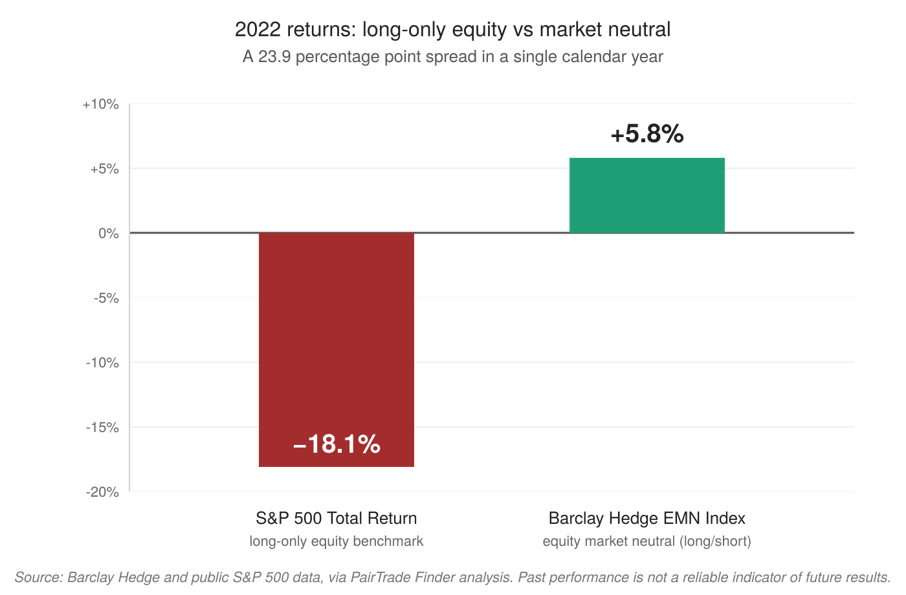
That is a 23.9 percentage point spread in a single calendar year. The EMN index does not depend on the S&P going up. It earns its return from relative mispricings between stocks.
Zoom out to the full 2021–2025 period and the risk-adjusted picture sharpens further:
Metric (Jan ’21 – Dec ’25) |
S&P 500 Total Return |
Barclay Hedge EMN Index |
| Annualised return (CAGR) | ~14.3% | ~11.3% |
| Annualised volatility | ~19.4% | ~4.2% |
| Sharpe ratio (approx.) | ~0.7 | ~1.9 |
| 2022 calendar-year return | −18.1% | +5.8% |
| Negative months (60 months) | many; clustered | only 7 |
The S&P slightly out-earned EMN on raw CAGR, but it required equity beta, roughly 4.5× the volatility, and a deep drawdown along the way. The EMN index produced comparable returns with one-fifth the volatility and only seven losing months out of sixty.
Sources: Barclay Hedge (EMN Index, Jan 2026 release), public S&P 500 TR data. Past performance is not a reliable indicator of future results.
Conservative leverage — the part most retail traders skip
Leverage is the kerosene that incinerates new traders’ accounts. But inside a properly hedged long/short portfolio, every short position naturally offsets some long exposure, so net market risk is dramatically lower than a long-only book. Our linked Equity Market Neutral Returns Analysis explores how a modest, IBKR-Portfolio-Margin-accessible ~2× exposure applied to the EMN profile produces materially higher returns than the S&P 500 Total Return while keeping the maximum drawdown in single digit %, precisely because the underlying volatility is so low. The key word is balanced, not “more.” Leverage applied to long-only equity is a different animal entirely.
A practical first-twelve-months plan for trading for beginners
Investopedia’s well-known beginner framework lists five steps: mental preparation, choose a broker, learn to analyse, practice on a simulator, develop a strategy. The version below, let’s call them stock market trading tips earned the hard way, is the more opinionated expansion we’d give anyone serious about lasting more than a year:
- Decide your horizon honestly. If you cannot — or will not — sit at a screen all day, you are not a day trader. Accept it. Pick swing.
- Pick one strategy (we suggest systematic and hedged) and follow it for at least 50 trades before judging it. Strategy-hopping is the most common beginner mistake. Fifty trades is the minimum sample at which you have any right to an opinion about whether the system works.
- Start on a simulator. Most reputable brokers offer paper trading. Use it for at least three months before risking real money. The cost is your time; the alternative cost is your capital. And your time.
- Risk a fixed small percentage per trade (commonly 0.5%–1% of capital). Position sizing is the single biggest determinant of long-term survival. Almost nothing else matters as much.
- Treat short selling as a skill to learn, not a stunt. It is the missing half of most retail toolkits, and the reason many accounts cannot survive a regime change.
- Journal every trade, including the reason for entry and exit. Patterns in your own behaviour emerge faster than patterns in the market. They will help you correct in-built emotional and/or behavioural biases.
- Read your statements monthly — and look at the cost lines, not the P&L. Slippage, commissions, financing. If those numbers are surprising you, your frequency is too high.
A measured way in
The trading population is growing fast and the tools have never been more accessible. But access without method is exactly what produces those 71%–79% loss rates. The honest beginner’s path is not glamorous: pick swing over day, system over discretion, hedged long/short over long-only, conservative leverage over heroic leverage. That combination is supported by more than thirty five years of indexed institutional data and several decades of academic research. It is also the version of trading you can practise for the next thirty years without losing your savings — or your weekends — to it.
That, in our view, is what good trading for beginners really looks like.
Capital at risk. This article is for educational purposes and does not constitute financial, investment or tax advice. Past performance is not a reliable indicator of future results. PairTrade Finder® is a systematic trading software platform developed and published by Equilibria Technologies Ltd., and is not a broker or financial adviser. Index data referenced from Barclay Hedge and public S&P 500 sources. Consider seeking advice from an FCA-authorised adviser before making investment decisions.