

Trade the relationship between two stocks — not the direction of the market.
PairTrade Finder® is the cointegration-based, market-neutral platform serious traders have used since 2008 to run a systematic pair trading strategy, with low correlation to market averages. Pick the tier that fits how you trade — 15-day free trial on every plan.
Three tiers. One systematic edge.
15-day free trial on Standard and Hedge Fund Edition. No payment required. Credit card sets up subscription. No charge for 15 days. Cancel anytime.

| Feature | Standard | Hedge Fund Edition | Institutional |
|---|---|---|---|
| Pricing | |||
| Annual price | $797/yr | $1,697/yr | from $4,950 |
| Monthly price | $87/mo | $179/mo | Annual only |
| Free trial | 15 days | 15 days | Demo on request |
| Money-back guarantee | 15 days | 15 days | Annual contract |
| Software | |||
| Full UA3 software | ✓ | ✓ | ✓ |
| License keys | 1 | 3 | 5+ |
| TOP 50 USA Stock Pair Stars | ✓ | ✓ | ✓ |
| Quarterly refresh timing | Standard | 7 days early | Standard |
| Video training course | ✓ | ✓ | ✓ |
| Signals & Research | |||
| 10 bonus Stock Pair Stars/quarter | — | Yes (Non-Disclosure Agreement) | ✓ |
| Coaching & Onboarding | |||
| Monthly 45-min 1-on-1 with Geoff | — | ✓ | Team onboarding |
| Submit 5 pairs/year to PTF team for backtests | — | ✓ | Custom scope |
| 30-min install session | — | ✓ | ✓ |
| Day-1 onboarding call | — | ✓ | ✓ |
| Support & Legal | |||
| Online Support SLA | 48–72hrs | 24hr priority | 24hr priority |
| Internal redistribution rights | — | — | ✓ |
Try the full product. Cancel before day 15 and you'll never be charged.
Don't love it? Email us within 15 days after paying and get a full refund. No questions. 30 days risk-free.
One-click cancellation. No retention calls. Subscription stops at period end.
License Terms — Personal Use Only
Each PTF Ultimate Alpha 3 license is for personal use only. By subscribing you agree to our Product End User License Agreement.
Multi-user and institutional licensing is available separately — see the Institutional tier above.
Built for Teams & Firms
PairTrade Finder® offers tailored institutional licensing for RIAs, small hedge funds, family offices, prop trading firms, university trading programs, and trading-education businesses. Pricing starts at $4,950/year for a 5-license team package with onboarding and internal use rights. Custom arrangements for larger teams, content rights, signals redistribution or white-label agreements available on request.
Contact Geoff to Discuss Your Needs →Frequently Asked Questions
What's a realistic monthly return I should expect from pair trading?
No honest vendor can promise you a monthly number — your results turn on the markets you trade, your leverage, your costs and your discipline. What we can do is show you the evidence and let you set your own expectations.
Pairs trading is a cointegration-based, market-neutral strategy: it targets the relationship between two related securities, largely independent of whether the market rises or falls. As context — not a forecast:
- The institutional benchmark. The equity-market-neutral hedge-fund category — funds running exactly this style — returned about 7.4%/yr net of fees over 2021–2025 (Sharpe ~1.3, volatility under 4%). Grossed up for typical fees that’s ~11%/yr, roughly 0.9% per month, at the modest ~1.5× leverage these funds run. (Barclay Hedge EMN Index.)
- Cointegration beats the textbook method. The widely-cited “distance” method loses most of its edge after trading costs. The cointegration approach PTF uses is different: Huck & Afawubo (2015) found cointegration-selected S&P 500 pairs deliver a high, stable and robust return after costs; Chen, Chen & Li document large, significant abnormal returns for equity pairs trading.
- Leverage and the retail edge. Market-neutral books are commonly geared 1.5–3×, and because of small size a retail trader can access smaller, less-liquid pairs that capacity-constrained funds can’t touch.
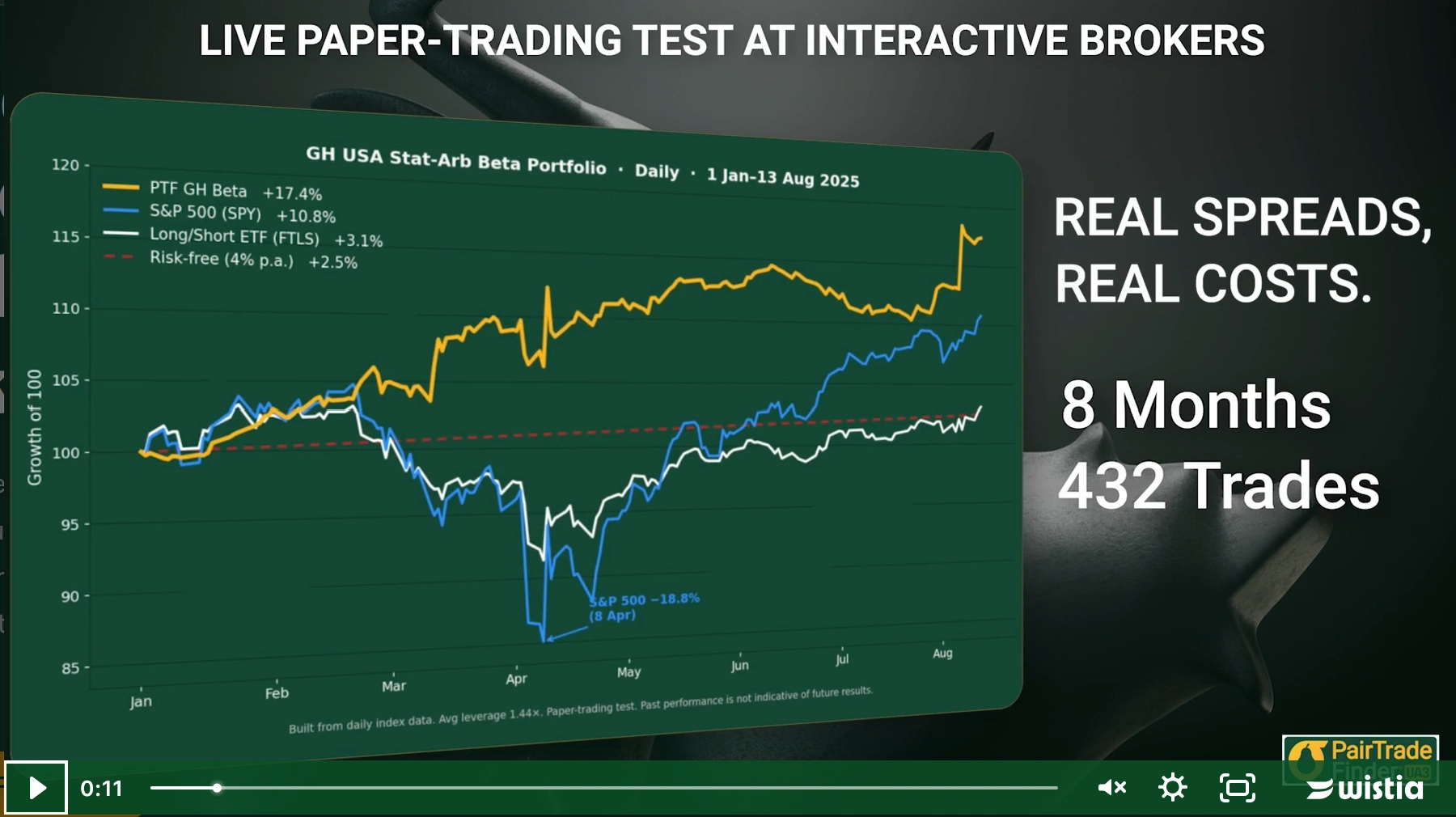
Our own paper-traded beta portfolio returned 17.4% over its first 7.5 months, at ~1.44× average leverage — about 2.2% per month, or roughly 1.5% per month unlevered (i.e. cointegration alpha, not a leverage artefact). We deliberately don’t annualise that: 7.5 months is an encouraging early signal, not a long-term track record, and live trading may carry frictions that paper trading does not, though IBKR simulated trading is quite accurate.
Taken together, a sensible expectation for a disciplined, cointegration-based, modestly-leveraged approach is on the order of ~1–2% per month over the long haul — emphasis on long haul and disciplined. The real draw is a consistent, low-correlation, risk-adjusted return stream (Sharpe well above the S&P 500’s ~0.66), not any single monthly figure. Expect flat and negative months along the way.
Index figures shown are adjusted to add back assumed fees and/or leverage and are not PairTrade Finder’s own results; academic findings cover specific historical periods and markets. Our paper-traded beta-portfolio result covers a 7.5-month period and is hypothetical — it reflects no real capital, execution, financing or slippage costs, was achieved with hindsight, and a period of this length is not a reliable predictor of long-term performance. Leverage magnifies losses as well as gains. Past performance is not indicative of future results. Trading involves substantial risk of loss and is not suitable for everyone. PairTrade Finder® provides software and education only — not investment advice — and guarantees no outcome.What's the minimum account size I need for this to make sense?
Does this work for futures and options, or just stocks?
Can I use PTF in my IRA or other tax-advantaged account?
What if the market crashes during my trial — will I get destroyed?
Do I need to be at my computer all day?
What's the difference between Standard and Hedge Fund Edition?
Can I upgrade from Standard to HFE later?
What if I'm based outside the US?
What broker do I need? Does this work with Interactive Brokers?
Not ready to subscribe? Get the 2026 PairTrade Finder® White Paper.
"US Statistical Arbitrage. A Systematic, Market-Neutral Alpha Strategy." Free, 21 pages, no spam — just the white paper.
No spam. Unsubscribe anytime.