
Tag Archives: Quantitative Trading

OU Half-Life Filter for Pair Trading

Faster Reversion = Better Profits in PairTrade Finder® UA3

One of the biggest hidden risks in pair trading isn’t finding a cointegrated relationship. It’s trading a pair that reverts too slowly to be profitable before costs, time decay, or market drift eat your edge.

That’s exactly why we’re adding the OU Half-Life Filter to PairTrade Finder® Ultimate Alpha 3. It’s a simple, powerful new layer that tells you how fast a spread will snap back — so you only trade the pairs that can actually make money in real-market conditions.
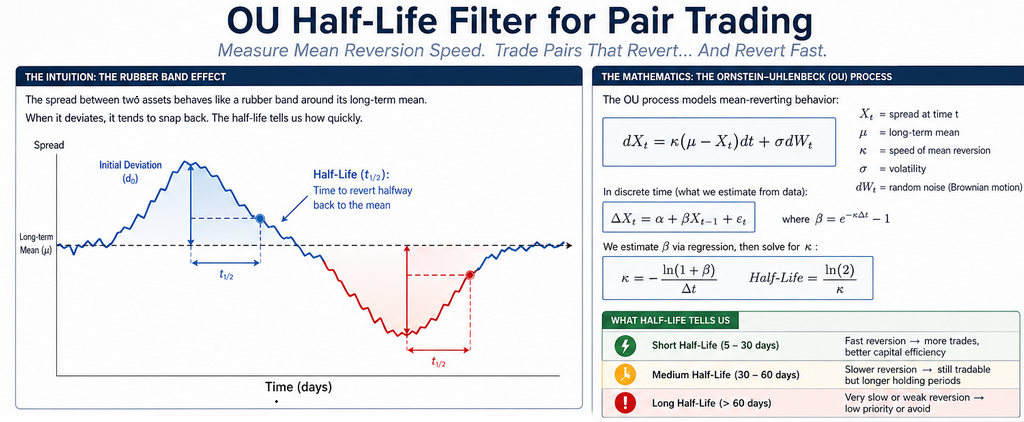
OU Half-Life Filtering in Pair Trading

Why Many Pairs Fail in Live Trading (Even If They Pass Backtests)

You run the scanner.

Read More →

Using Sentiment Scores In Stock Pair Trading

Filtering Event Risk in Modern Statistical Arbitrage The Real Problem in Pair Trading Isn’t Signal – It’s Classification

sentiment scores in stock pair trading

Pair trading is often framed as a statistical exercise: identify a spread, measure its deviation, and trade the reversion. But in practice, the real challenge is not finding divergence – it is correctly interpreting it. This problem is where using sentiment scores in stock pair trading comes in to play.

A widening spread can mean one of two things:

  • A temporary dislocation driven by liquidity or noise
  • A structural repricing driven by new information

Traditional stat arb models –

Read More →

Beating the S&P 500 Without Market Direction: Inside Equity Market Neutral Trading

Most traders intuitively understand that returns mean very little without context. What ultimately matters is how those returns are generated, the drawdowns required to earn them, and whether the strategy survives hostile market environments.

That is precisely why equity market neutral (EMN) trading strategies have been a core allocation for institutional capital for decades—and why they are now becoming accessible to sophisticated retail traders.

In this post, we’ll walk through a real institutional dataset, compare it directly to the S&P 500, and then run a simple but powerful thought experiment: what happens if a retail trader applies modest leverage—available today at Interactive Brokers—to an institutional EMN return stream?

Read More →