


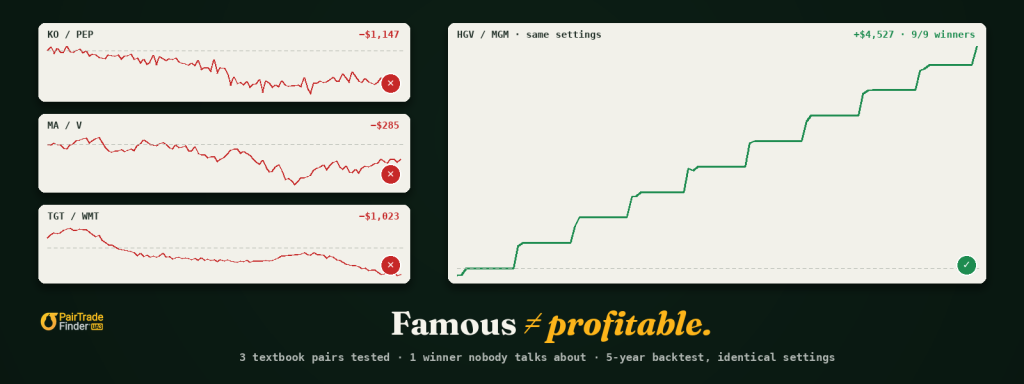
Ask anyone which stock pairs to trade and you’ll hear the same three names: Coke and Pepsi. Visa and Mastercard. Target and Walmart. They’re in every textbook, every YouTube video, every forum thread. Famous companies, obvious rivals, surely perfect pairs.
I ran all three through a five-year backtest last week. Every one of them lost money.
This isn’t a trick. Same settings for every test, disclosed in full below, straight out of our software. And the punchline isn’t that pairs trading doesn’t work. We also show how the same test, same settings, on a pair almost nobody talks about, produced nine trades and nine winners, with over $4,500 in PnL ($10,000/leg). The punchline is that the market doesn’t pay you for trading famous names. It pays you for doing the screening work. Here’s the evidence.
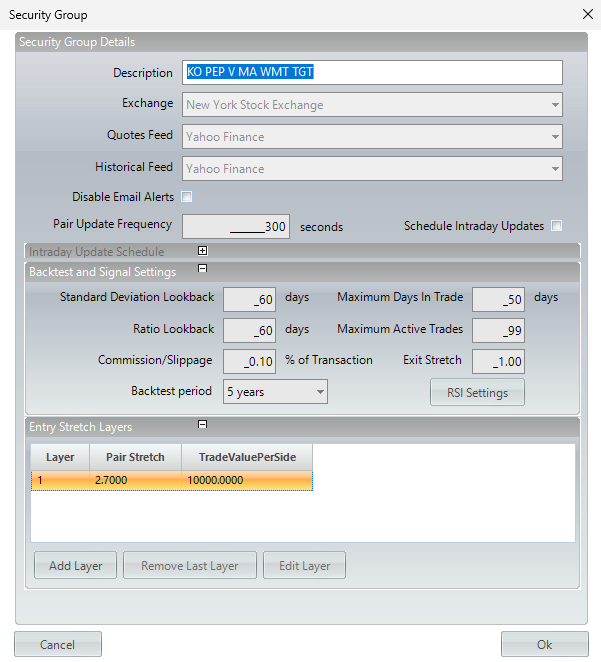
The test — identical for all four pairs
Five years of daily adjusted close data. Entry when the pair ratio stretches +/-2.7 standard deviations from its 60-day mean; exit at +/-1.0sd. $10,000 per leg, dollar-neutral. 0.10% commission and slippage per transaction, maximum 50 days in a trade. No optimisation per pair, no cherry-picking — one rulebook, four pairs, and the chips fall where they fall.
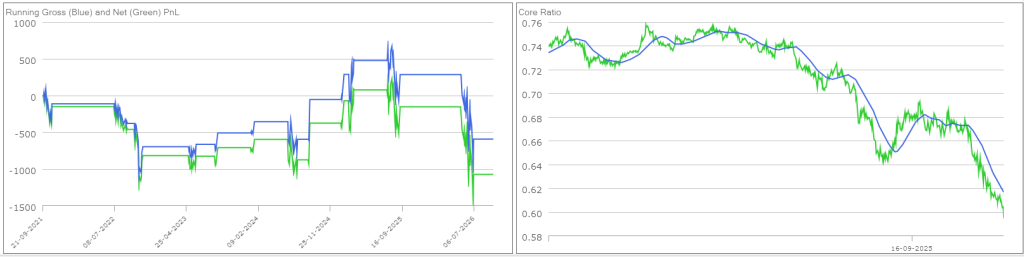
KO / PEP — the classic that quietly died
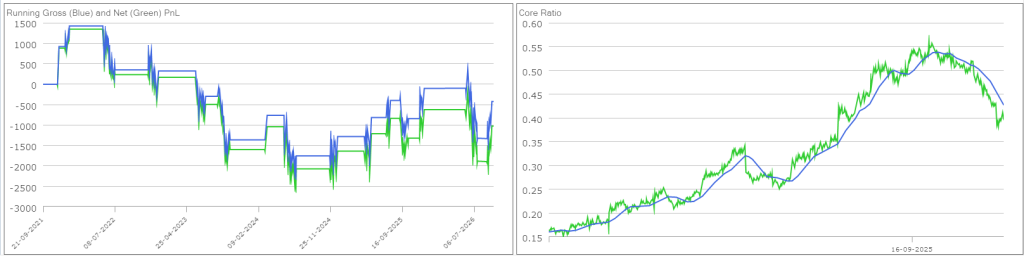
The most famous pair in the world, and here’s its five-year report card: 12 trades, 42% winners, net loss of -$1,069. Maximum drawdown 16.4%. Look at the ratio chart and you can see why — for three years it oscillated like a pair should, then from 2024 it just… left. The ratio walked from 0.74 down to 0.60 and never came back. These are still two great beverage companies. But the market has been repricing them on different stories, and the old leash is gone. Cointegration reads 0.38 on average — far below anything we’d trade.

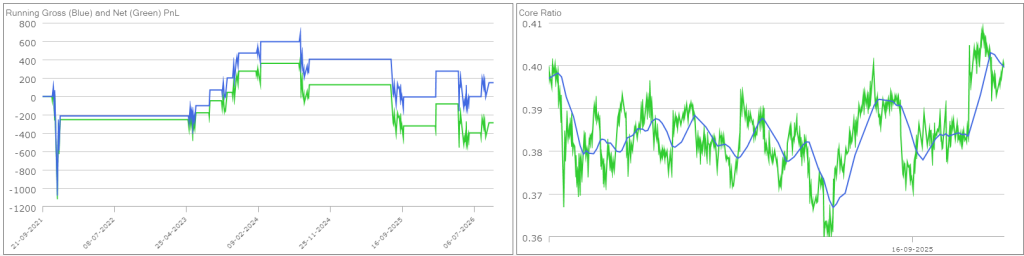
MA / V — the correlation trap
This one teaches the most expensive lesson in pairs trading. Mastercard and Visa are 86% correlated — the highest of anything I tested. Surely the perfect pair? Net result: minus -$285, with commissions eating a small gross profit alive. The problem is that correlation and cointegration are different animals. These two move together every single day — and their ratio still drifts wherever it pleases over months, because nothing anchors it. Cointegration: 0.43. The lines wiggle in sync; the leash doesn’t exist. If you take one sentence from this post: correlation tells you they dance together, cointegration tells you they go home together. Only the second one pays.

TGT / WMT — the trend that never snapped back
The ugliest of the three. Fifteen trades, net loss of $1,023, and a maximum drawdown of 34% — the kind of number that ends accounts. The ratio chart tells the story: it tripled between 2021 and 2025, then halved. That’s not mean reversion, that’s a migration. Walmart and Target sell to the same shopper, but they’ve spent five years diverging structurally — and a mean-reversion system trading a trending ratio is a machine for buying tickets on the wrong train, fifteen times.

Same test, different pair: HGV / MGM
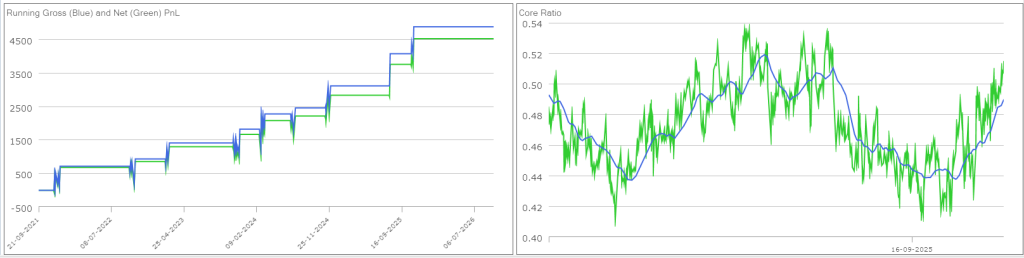
Now the control group. Hilton Grand Vacations and MGM Resorts, the sweet little Vegas pair we highlighted last week and a pair you will not find in any textbook. Identical settings: nine trades, nine winners, net profit +$4,527, average $503 per trade, maximum drawdown 6%. Cointegration 0.80 average and 0.97 today — double the famous pairs. The equity curve is a staircase. We’ve published a full case study on this pair, including 36 months of out-of-sample tracking, if you want the long version.

The real lesson — pairs die, and screening never stops
Here’s what nobody selling you a pairs course will say: KO/PEP was probably a fine pair once. Relationships drift. Businesses diverge. A pair that screened beautifully in 2021 can be a slow leak by 2024, and the numbers above prove it. Which means the work isn’t finding ten good pairs once. It’s re-testing correlation, cointegration and mean-reversion speed across thousands of combinations, every quarter, forever, pruning the dead and promoting the living.
That is precisely the job we built Ultimate Alpha 3 to do. The screener runs the statistics across the whole market continuously, and our Top 50 list is the output: the fifty pairs that currently pass every gate, re-verified and refreshed so you’re never trading last year’s relationship. A hedge fund’s research desk, in a box, for the price of a data feed.
See what’s on the Top 50 right now — start your free 15-day trial.
Backtest results are hypothetical, do not represent actual trading, and past performance never guarantees future results. PairTrade Finder is trading software and education, not investment advice. Trading involves substantial risk of loss.