

A surprising wildlife study has traders asking a serious question: could environmental toxins be quietly lowering your testosterone — and with it, your edge in the markets?

You may have heard Joe Rogan discuss it recently on his podcast: male alligators in polluted Florida lakes exposed to endocrine-disrupting chemicals (pesticides like DDT/DDE) developed significantly smaller reproductive organs and disrupted hormone profiles.
The research, pioneered by Louis Guillette’s team at the University of Florida, has been replicated across multiple lakes and remains one of the clearest real-world demonstrations of how environmental toxins can impair testosterone production and reproductive function.
Why Testosterone and Trading Performance Are Directly Linked
Here’s the point: hormones — especially testosterone — drive risk tolerance, focus, confidence, and endurance. Those traits are the engine behind making decisive trades, scaling businesses, and sticking to long-term wealth plans.
When environmental factors (plastics, endocrine disruptors, pesticides) pull your baseline down, your appetite for risk and grind can follow (and your fertility). That’s not just biology; it’s a potential leak in your financial engine.
Why healthy hormonal balance matters for trading and wealth:
- Faster decisions: higher energy and clarity reduce hesitation in executing edge plays
- Consistent discipline: hormonal stability helps you stick to rules during drawdowns, no emotional freak-outs
- Risk calibration: balanced hormones preserve willingness to take informed risks that compound returns
- Long-term grit: motivation and resilience keep you building while others burn out. That’s testosterone talking
Don’t believe us? How about some peer-reviewed evidence?
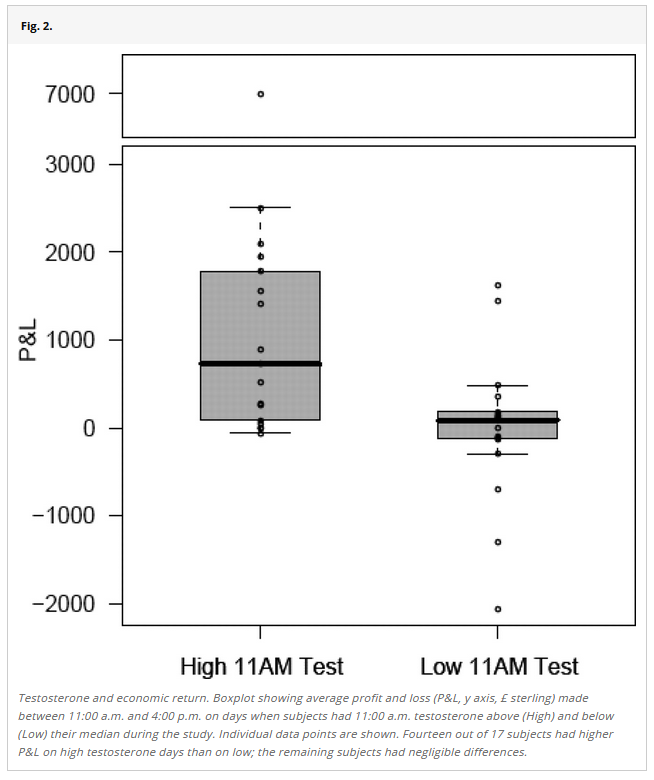
In 2008, Cambridge researchers John Coates and Joe Herbert published a landmark study in the Proceedings of the National Academy of Sciences. They tracked 17 male traders on a London trading floor and measured their morning testosterone levels daily.
The result was striking: days with higher endogenous testosterone strongly predicted greater profitability that same day.
Testosterone & Trading: Economic Return
Source: Coates, J. M., and J. Herbert. 2008. “Endogenous steroids and financial risk taking on a London trading floor.” Proceedings of the National Academy of Sciences of the United States of America. https://www.ncbi.nlm.nih.gov/pmc/articles/PMC2329689/
Higher morning testosterone correlated with increased risk-taking precisely in the direction of the trader’s informational edge. The effect was not trivial — it translated directly into better daily P&L.
The Modern Threat to Your Hormonal Edge
Everyday exposures to plastics, phthalates, BPA, pesticides, and other endocrine disruptors are now ubiquitous. For traders who sit for long hours, drink from plastic-lined cups, and operate under chronic stress, the cumulative impact can quietly erode baseline testosterone — and therefore trading performance.
Five Evidence-Based Steps to Protect your Testosterone and Trading Edge
- Audit endocrine-disrupting chemical exposures: reduce single-use plastics and obvious toxin sources in your home and food chain. Are you drinking your piping-hot morning coffee, made in a plastic coffee machine, out of a store-bought paper cup (lined with plastic) with plastic lid? Maybe you are not going to be at your testosterone best at 11am…find great suggestions here: https://opsociety.org/theplasticdetox/protect-yourself-and-your-family/
- Prioritize 8 hours of consistent, high-quality sleep — A controlled study by Leproult & Van Cauter (2011) (1) showed that restricting young men to five hours of sleep for one week lowered daytime testosterone by 10–15%, an effect comparable to aging a decade.
- Use heavy, multi-joint resistance training — Kraemer & Ratamess (2005) (2) and subsequent reviews confirm that protocols stressing large muscle mass with sufficient volume and intensity produce a reliable acute rise in testosterone immediately post-workout (typically 15–60 minutes, sometimes up to two hours).
- Support production with Vitamin D3 and zinc — Meta-analyses (Abu-Zaid et al., 2024 (3); Te et al., 2023 (4)) show that correcting deficiencies in both nutrients is associated with higher total testosterone, particularly when baseline levels are low.
- Test and track — Get baseline bloodwork (total and free testosterone, SHBG, Vitamin D, zinc, estradiol) and re-test after 8–12 weeks of changes. Data beats speculation.
Testosterone & Trading: Bottom Line
Your net worth is the product of repeated high-quality decisions. Protecting the biological engine behind those decisions — your testosterone levels — is not fringe wellness advice. It is professional risk management.
To staying sharp, practicing resilience and compounding gains,
The PairTrade Finder® Team
References:
[1] Leproult, R., & Van Cauter, E. (2011). Effect of 1 week of sleep restriction on testosterone levels in young healthy men. JAMA, 305(21), 2173–2174.DOI: 10.1001/jama.2011.710 https://jamanetwork.com/journals/jama/fullarticle/1029127
[2] Kraemer, W. J., & Ratamess, N. A. (2005). Hormonal responses and adaptations to resistance exercise and training. Sports Medicine, 35(4), 339–361. https://pubmed.ncbi.nlm.nih.gov/15831061/
[3] Abu-Zaid, A., et al. (2024). The Impact of Vitamin D on Androgens and Anabolic Hormones in Men: A Systematic Review and Meta-Analysis. Diseases, 12(10), 228. https://www.mdpi.com/2079-9721/12/10/228
[4] Te, L., et al. (2023). Correlation between serum zinc and testosterone: A systematic review.
Journal of Trace Elements in Medicine and Biology. https://pubmed.ncbi.nlm.nih.gov/36577241/
Disclaimer
This article is for informational and educational purposes only and is not intended as medical, health, or financial advice. PairTrade Finder® and its team are not licensed physicians, registered dietitians, or financial advisors. Any discussion of hormones, supplements, sleep, training, or environmental factors is based on published peer-reviewed research and should not replace personalised advice from qualified healthcare or financial professionals. Individual results vary. Past trading performance is not indicative of future results. Always consult your doctor before making changes to diet, exercise, sleep, or supplementation, and consult a licensed financial advisor regarding your investment decisions. No claims are made regarding the prevention, treatment, or cure of any condition.